
Fresh from a sold-out and critically acclaimed run at the Edinburgh Festival Fringe, Leigh Douglas’ one-woman show, ROTUS: Receptionist Of The United States, is set to arrive in London this January, transferring to Park Theatre for a limited engagement. Tickets are available now. Written and performed by queer, Irish-American comedian Leigh Douglas, the razor-sharp political satire examines the women operating behind America’s most powerful political figures—and the personal, moral, and political costs of unwavering loyalty to power.
This article may include affiliate links. Click here to read our full Affiliate Disclosure. If you make a purchase through one of these links, we may earn a commission at no additional cost to you.
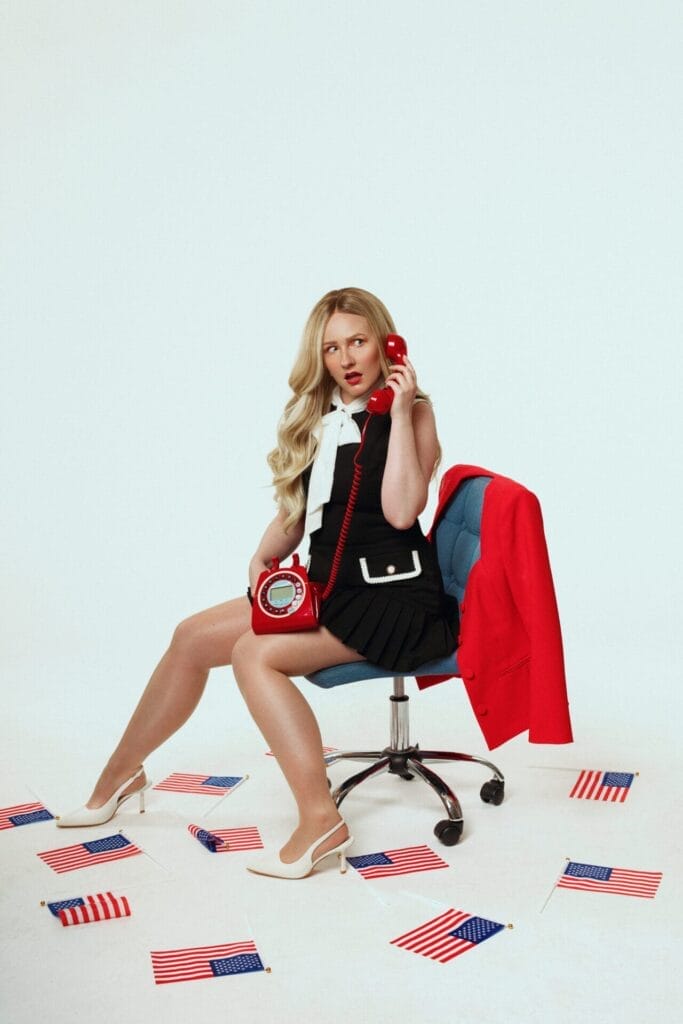
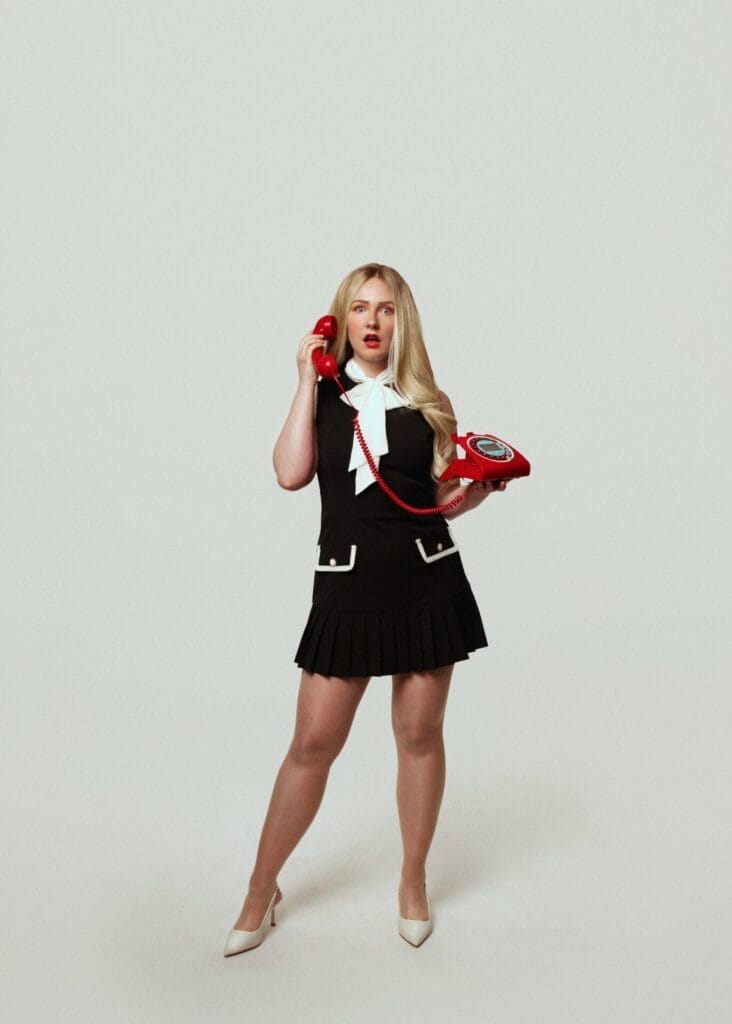
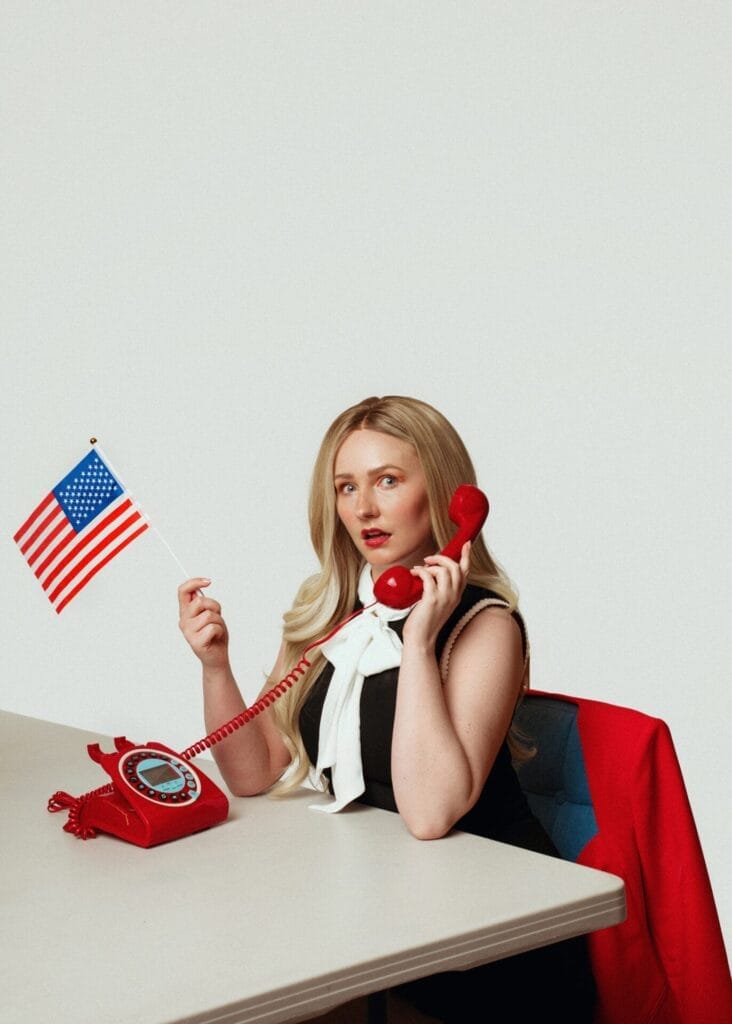
Blending theatre, stand-up, and cabaret, ROTUS follows Chastity Quirke, a fiercely ambitious White House receptionist whose devotion to the system she serves begins to fracture. Inspired by real-life figures including Cassidy Hutchinson, Alyssa Farah, and Karoline Leavitt, the show interrogates “pick-me patriotism”, internalised misogyny, and the pressures placed on women within hardline conservative politics.
Ahead of the London run, directed by Fiona Kingwill, Leigh Douglas answered Good Star Vibes’ questions via email, reflecting on the inspirations behind ROTUS, the impact of its sold-out Edinburgh Fringe run, and how the show has evolved as it moves to the Park Theatre. She also spoke candidly about the wider political and cultural conversations the work engages with, including making a clear and personal statement in defence of trans rights, while responding to the rhetoric and cultural forces currently shaping public debate around the LGBTQ+ community.
ROTUS draws inspiration from real figures such as Cassidy Hutchinson and Alyssa Farah, as well as one of the most talked-about White House press secretaries of all time, at the moment, Karoline Leavitt. What first led you to explore the world of conservative women who remain loyal to powerful political systems and the men who lead them?
I have always been fascinated by conservative American women. I moved to the United States from Ireland as a pre-teen with an Irish self-declared socialist Dad and a die-hard Labour voting Brummie Mum. My first friend I made in the United States marched straight up to my Dad, the first time she came over to my house, and asked, “My Daddy wants to know if you’re a Democrat or a Republican.” When my Dad answered, “Frankly, Bethany, I’m a socialist,” her eyes bugged wide in horror.
As it turned out, my new friend came from a deeply conservative Mormon family, and she went on to try to convert me by bringing me to various youth groups and telling me I was sinning by being a vegetarian (because Jesus ate meat in the Bible). I went on to have friends in high school who had gun racks up on their walls and who cried when Barack Obama got elected.
Being thrown into that world as a young person, having every belief I’d been raised with questioned, and having zealous young women trying to save my soul and convert me to Republicanism was quite the education. I see a lot of echoes of those girls I went to high school with in women like Cassidy Hutchinson and Karoline Leavitt.
You grew up between Ireland and the US—two places with their own political narratives and cultural contradictions. How did this shape your perspective when writing ROTUS?
It’s been fascinating to watch my two home nations almost change places over the course of my lifetime. The Ireland I was born into in the 1990s was still a very religious, conservative country. Very few people in Ireland had a friend of a different religion, let alone a friend of a different ethnicity. I am of the last generation of Irish women who will have the lived experience of an Ireland without abortion rights, where pregnancy was a visceral fear and an abortion meant flying to an unfamiliar city in the UK, often alone.
When I first came to America, my new American friends baulked at the conservative country I told them about when I talked about Ireland. I have now lived long enough to see abortion rights taken away in many places in the United States. Ireland has become a liberal country, while in the United States, LGBTQIA+ rights are being stripped back, the Voting Rights Act is under siege, and many American women are advocating that a woman’s place is in the home as a wife and mother.
I was proud to be one of the young women who flew home to vote in the Repeal the 8th referendum [campaign] in Ireland in 2018. I feel Irish women have a powerful warning for America about what the realities of a country without abortion rights look like. While the show doesn’t necessarily touch on abortion directly, all the MAGA rhetoric ultimately disenfranchises women and puts them back in a world that looks a lot more like 1950s Ireland under the Catholic Church than a liberal democracy.
The show had a sold-out run at the Edinburgh Fringe with incredible reviews. What did you learn from that month-long run that you’re now bringing into the London transfer?
I was worried people wouldn’t want to look at what’s happening in America or that they wouldn’t yet be ready to laugh at it. Thankfully, neither of those things proved to be true. If anything, it felt like people were looking for an outlet for their grief and their rage. I think I learned that the show can be as raucous and anarchic as we want and that, actually, the more of a rager I have with the audience in the first half of the show, the more ready people are for the emotional catharsis of the second half.

Critics described the show as “razor-sharp”, “frightening”, and “brilliantly political”. Were there particular reactions in Edinburgh that influenced how you’re approaching the Park Theatre run?
There were some Americans who came to the show and had a good cry. If people want to come to the show to grieve, that is absolutely allowed. I feel the show is doing what it should when the person who’s in tears over the state of their nation is also the person laughing the hardest. Edinburgh made me realise how important the joyful moments in the show are. If people arrive at the theatre feeling defeated, I want them to leave feeling hopeful.
Chastity Quirke embodies the “pick-me” girl figure in conservative politics. What was important to you in balancing satire with empathy for a character who genuinely believes in the system she serves?
Everyone has a context, and a big part of why I wanted to write the show was to understand why young women could ever feel drawn to the conservative political cause in the first place. When I read the memoir of Cassidy Hutchinson, the Trump aide who testified against him and her former boss, ex-White House Chief of Staff, Mark Meadows, in the January 6th investigation, the most interesting part of it, for me, was the context she provided for her own political views.
Cassidy Hutchinson and I are a similar age, and I could never imagine myself agreeing to work in the Trump White House. Yet Cassidy Hutchinson had made that decision and then done a one-eighty to testify against him. I think satirizing those who are doing harm is important to any vibrant democracy. I also think it is important to honor the strength of those who have the humility to change their own mind.
There is a reason why I wrote the show about the fictional character of Chastity Quirke rather than depicting a real-life Trump staffer. I don’t want to make a personal attack; I want to identify trends and satirize the movement as a whole, not the individual.
Internalised misogyny and ambition are major forces in the play. What do you think is the most surprising or misunderstood aspect of how these forces shape conservative women in politics?
As we saw with the way Hilary Clinton’s debate performances were perceived in 2016, women in politics are much more likely to be derided for being hysterical. If a woman has political ambitions, it’s therefore easier for her to gain power if she embraces tradition, doesn’t rock the boat of the establishment, keeps herself emotionally buttoned up and takes the most hardline positions against the oppressed so as not to be seen as weak.
This was the playbook that made Margaret Thatcher the first female Prime Minister. Female political candidates and staffers in conservative politics are rewarded for showing a brazen disregard for emotional sensitivity and a contempt for emotional intelligence. This allows conservative women to overcome their gender to attain political power. To counterbalance divorcing themselves from a feminine emotionality, however, these women must then hyperfeminize their personal appearance in order to uphold the traditional gender roles they espouse.
Chastity’s journey from absolute loyalty to reluctant self-awareness is central to the story. Which moments in her evolution matter most to you as a performer?
It was important to me that Chastity’s emotional connections to other women be central to the unraveling of her loyalty to MAGA. Not only do I delight in writing multiple compelling women into a narrative, but I’m also uninterested in depicting women as unable to get along or support each other, no matter the context. It makes sense to me that for a woman to deconstruct her whole political belief system, something would have to impact her or one of her friends in a personal, emotional way.
The show uses stand-up, cabaret, and theatre. How does this blend help you communicate themes that might otherwise feel too heavy or too political?
So much of this show is about the conservative performance of femininity. A huge part of the tradition of femininity in the United States comes from cabaret, burlesque, and comedy, whether it be Marilyn Monroe singing “Happy Birthday” to JFK, little girls competing in beauty pageants or Katherine Hepburn duking it out with Spencer Tracey in a 1950s screwball comedy. The femininity promoted by conservative politics is a patchwork of all of this history, and it therefore felt important to depict overtly.
The women of the conservative Make America Hot Again movement seem to imply it is a moral failing on the part of women when they don’t live up to male fantasies of womanhood. There is a contradiction at play between the “family values” of the right and the sexualised subtext for the way conservatives speak about all women in public life. I wanted to use these forms of performance to show how Chastity’s sex appeal works for her as a professional tool until it doesn’t.

You draw parallels between conservative women in the US and the UK. Why do you think figures from Cassidy Hutchinson to Kemi Badenoch seem to follow such similar political “scripts”?
It serves individual women to uphold patriarchy. I think most women have experienced being called a “psycho” or have been accused of overreacting to misogyny. It’s gratifying to be picked out by men in power as an acceptable woman. In order to do that, you cannot diverge from their agenda or beliefs in any way. You have to be more by the book than any individual man. The minute Cassidy Hutchinson broke the mold and decided that the insurrection on January 6th was unacceptable to her was the moment she was expelled from conservative politics.
One theme in the show explores how to communicate with people who don’t see themselves as bigoted but still uphold harmful structures. What insights has this project given you about starting that kind of conversation?
There is always a balance between accountability and compassion with anyone upholding harmful structures. That balance is different depending on where the individual sits in within the power structure. While the architects of bigotry absolutely deserve to face accountability, their footsoldiers are winnable. In the case of the United States, if there is ever a hope of growing the democratic coalition, it’s important there be a place for MAGA defectors within the democratic party.
I was a bridesmaid at a wedding a couple of years ago where the groom’s family were MAGA. My high school best friend now has a baby who will grow up with MAGA grandparents and aunts. I decided not to ruin my friend’s wedding by hitting any of those people with liberal talking points. The father of the groom even told me how nice it was to come together with people with “shared family values”. Little did he know I was a snowflake, lefty liberal lesbian.
The fact is, though, I do have my own family values. Chastity was inspired by the people at that wedding as much as by any public figure. I’m sure most of them would vote against my right to marry my girlfriend, but they are also now the family of a child I care about. When I think about starting these conversations, I think about my friend and her baby and the conversations we’ve had about what happens with her in-laws if her baby one day comes out as trans, or gay, or marries someone from another country.
Ultimately, we have to have hope for human goodness, otherwise we’re writing off half the population of the United States.

As a queer, Irish-American lesbian, how did your identity inform your approach to portraying someone whose political worldview stands in opposition to your own?
It’s absolutely delicious to step into the shoes of someone whose views I detest. It feels like beating the bigots at their own game. They’d love to think that they could never be impersonated by someone like me, and therefore, getting into their skin is all the more satisfying.
As a member of the LGBTQ+ community, you’ve witnessed the sharp rise in hostility toward trans people—from political rhetoric in the US, including presidential executive orders, to the recent UK Supreme Court judgment and the ongoing influence of high-profile figures such as a certain Scottish author that the community refer to simply as Joanne. As debates and attacks on trans rights continue, how has this moment struck you personally? What do you think it reveals about the wider climate for the LGBTQ+ community? And is there anything you would like to say to those who have been vocal in opposing or critiquing trans rights?
First of all, protect the dolls, always and forever. It is not a responsibility I take lightly as a cis lesbian to stand with my trans sisters (nonbinary friends and trans guy hotties). Second, I would say to anyone who identifies as a TERF, your attention is being misdirected. You are being told that trans women are to blame for the fact that you feel unsafe. Trans women are women, and no man would go through the herculean struggle trans women have to go through to become themselves.
If a man wanted to be a threat to you, he would do so without pretending to be trans. Trans women deserve our protection, not our fear. Some of the most beautiful female friendships I have are with trans women. They want to connect with you, not harm you. And they’ve missed out on lots of the fun of being a girl for so long, it’s our duty to show them just how fun it can be to be one of the girls.
We are living through a moment in which queer people have never been more visible, but that doesn’t mean we are anything new or a threat to your life and how you choose to lead it. The path of progress is not linear; for every two steps forward, we take a step back, but that doesn’t mean that, in sum, the future isn’t moving in our favour.

We completely agree with you on every level! Protect the dolls! Despite the challenges, and on a positive note, true to the spirit of Good Star Vibes, we’ve also seen extraordinary moments of solidarity—from more than 100,000 people attending London Trans+ Pride 2025 to the huge turnout at Budapest Pride 2025. What do these displays of collective support mean to you, and what do they signal about the strength and resilience of the LGBTQ+ community today?
The LGBTQIA+ community is at its strongest when it stands together. My own letter, L, comes first because of the way lesbians stood by queer men during the AIDs crisis. We would all do well to be led by that example. We cannot be legislated out of existence, though many nations have tried. We are missing many of the elders we should have had were it not for AIDs, but it is our job to be those queer elders for the young people who are looking for mentorship, support, and advocacy. I am very moved by displays of allyship and solidarity within the LGBTQIA+ community.
That really resonates—queer people have always existed, and now we’re finding ourselves becoming the elders, mentors, and protectors we didn’t have the opportunity to grow up with. Shifting back to ROTUS and your portrayal of Chastity, a character fiercely loyal to a system you personally critique, what was the most challenging part of stepping into her mindset?
As someone who is apt to critique powerful straight cis white men of a certain age, it was difficult to get myself into the mindset of someone who so unquestioningly reveres men purely by virtue of their power. What has been enormous fun, though, is that, as it’s a one-woman show, I also get to embody these men themselves.
You’ve spoken about the personal and political costs for women who stay loyal to power, “almost no matter the consequences”. What costs stand out to you most when looking at real-world examples?
Cassidy Hutchinson sacrificed her anonymity and her personal safety when she stood against Donald Trump. Liz Cheney sacrificed not only her seat in the House of Representatives, but her place in the Republican community. We are yet to know what the human cost is for the women who remain loyal to Trump. What is clear is that no one stays in his favour forever, as we’re seeing now with Marjorie Taylor-Green.
So while loyalty does buy these women short-term political success, their careers are ultimately eaten up by the MAGA machine. Thus far, it seems, there is no role in public life available to women on the other side of their tenure as a Trump favourite.
The transfer to Park Theatre marks a major new chapter for ROTUS. What excites you most about staging the show in London, and what does this venue allow you to explore differently?
The Park really allows us to bring a more fully realised design concept for the show, which is really exciting. The added space, physically for me as a performer, also means I can allow the performance to breathe and go full-pelt with the characters, as my nose will no longer be inches away from the audience as it was in Edinburgh. I’m really excited about how this will deepen the experience of the show for the audience.
Finally, when audiences leave Park Theatre, what do you hope they’ll be thinking about? What impact do you hope the London run will have?
I’d love audiences to leave the show feeling energised and a bit riled up. There’s something about political satire and political thrillers that feels like a very male space. I hope that this show allows the girlies to feel more politically engaged. No one can afford to be apolitical in 2025 [and beyond], and I would hope that audiences find this show and use it as an access point for their own political engagement, whether that means simply voting in the next election or taking to the streets.
Thank you, Leigh Douglas, for taking the time out to answer our questions and for sharing such thoughtful, candid, and powerful reflections on ROTUS, the current political climate, and the importance of solidarity within the LGBTQ+ community.
With its London transfer to Park Theatre, ROTUS: Receptionist Of The United States arrives at a moment when conversations around power, gender, and political complicity feel especially urgent. Through satire, empathy, and unflinching honesty, Leigh Douglas offers audiences not only sharp commentary but an invitation to engage, question, and reflect. As ROTUS continues its journey beyond the Fringe, it stands as both an entertaining and provocative piece of theatre—one that challenges audiences to consider where loyalty lies, what it costs, and how change begins.
ROTUS: Receptionist Of The United States runs at Park Theatre, London, from January 20 to February 7, 2026. Tickets are available to purchase right now. Accompanying the London theatre show is the release of Leigh Douglas’ debut playtext novel, which shares the same title and is available to purchase in paperback format from Amazon, via CNC Books. If you have any extra spare time, we highly recommend you check out her podcast show with Fiona Kingwill, which focuses on The West Wing, which is available to listen to on Apple Podcasts.
Follow Leigh Douglas on social media here:
Share this article and tag us @GoodStarVibes to let us know what you make of our interview with Leigh Douglas on her upcoming London theatre show ROTUS.
Have any thoughts?
Share your reaction or leave a quick response — we’d love to hear what you think!
-
 0
0 - 0
- 0
- 0
- 0
- 0


