
At first glance, “Unbreakable Rhythm: My Journey Through Music, Wellness, and Mental Strength” might appear to sit comfortably alongside the many musician memoirs already on the market. Yet from its opening pages, it becomes clear that Frank Zummo is not interested in delivering a greatest-hits recap of a life spent behind the drum kit. Instead, “Unbreakable Rhythm” positions itself as a book about mindset, discipline, and survival—one that uses music as its framework rather than its destination.
This article may include affiliate links. Click here to read our full Affiliate Disclosure. If you make a purchase through one of these links, we may earn a commission at no additional cost to you.
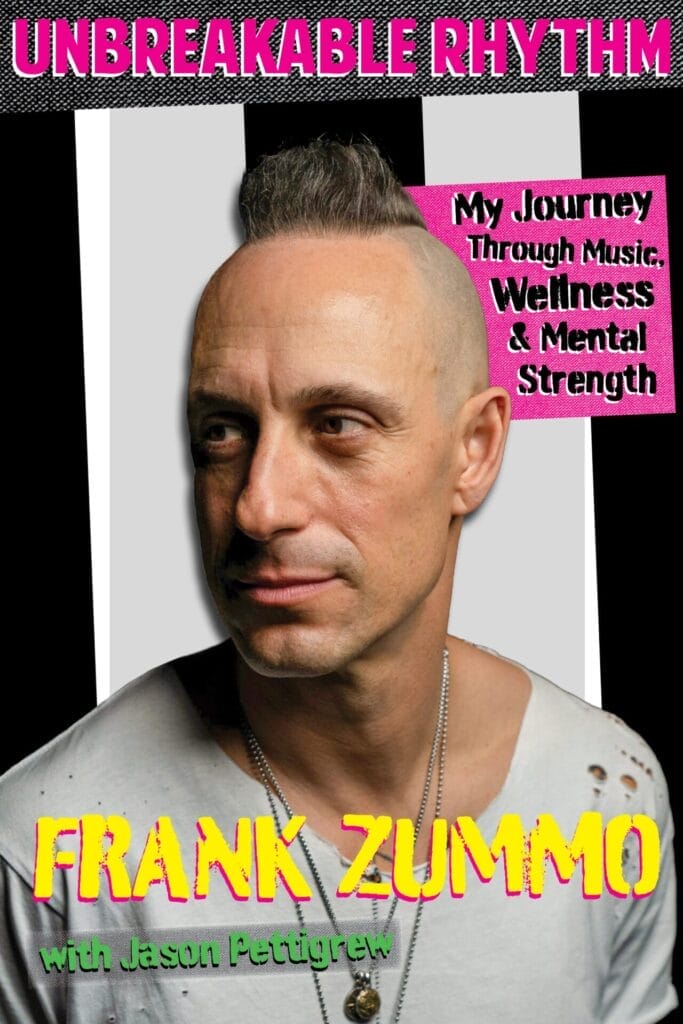
Frank Zummo, best known as the drummer for Sum 41 and a founding member of Street Drum Corps, is upfront about what this book is and is not. This is not a catalogue of backstage excess or tour bus mythology, nor does it rely on celebrity name-dropping for momentum. While recognisable figures and defining career moments naturally appear throughout, they are rarely the point. The focus remains firmly on the internal rhythm that has guided Frank Zummo from childhood to the present day: a commitment to consistency, personal responsibility, and growth, even when circumstances are chaotic or uncertain.
The book traces Frank Zummo’s early life on Long Island, where music was embedded into family routine rather than treated as a distant dream. One of the most striking early passages recounts how his parents recognised something unusual when he first sat behind a drum kit at just two years old. Rather than romanticising this moment as destiny, Frank Zummo treats it as the beginning of a long, disciplined process—one that required structure, repetition, and sacrifice long before any external recognition arrived. His recollections of listening obsessively to records by Led Zeppelin, James Brown, and Mötley Crüe help establish an important theme that recurs throughout the book: groove and feel matter just as much as technical skill.
As “Unbreakable Rhythm” progresses, the narrative expands beyond formative influences into the less glamorous realities of chasing a life in music. Frank Zummo does not shy away from discussing rejection, financial instability, and the emotional toll of constantly proving oneself. His reflections on being bullied at school, struggling to fit into rigid systems, and navigating scenes that often felt hostile or unsafe add a grounded honesty to the book. These sections are particularly effective because they avoid framing hardship as something to be “overcome” quickly. Instead, Frank Zummo acknowledges how these experiences shaped his mental resilience—sometimes productively, sometimes painfully.
Part of this openness is reinforced by how the book itself came into being. “Unbreakable Rhythm: My Journey Through Music, Wellness, and Mental Strength” originated from an extended recorded conversation between Frank Zummo and music journalist Jason Pettigrew, captured backstage following a School of Rock workshop in Chicago. That discussion, sparked after a day spent performing and mentoring young musicians, became the foundation for the book’s introduction and broader structure. This origin helps explain the memoir’s natural, conversational pacing, allowing reflection and vulnerability to take precedence over polish or performance.
One of the book’s strongest elements is its attention to wellness and mental strength, which is woven throughout rather than isolated as a separate theme. Frank Zummo writes candidly about anxiety, fear, and self-doubt, especially during periods of transition. His discussion of fear—influenced in part by Kristen Ulmer’s “The Art of Fear”—reframes it as something to be understood and worked with, rather than eliminated. This perspective feels particularly relevant in a creative industry that often rewards relentless output while neglecting mental sustainability.
The sections covering the formation and growth of Street Drum Corps offer insight into Frank Zummo’s entrepreneurial mindset and his belief in community-building. What began as an unconventional percussion project evolved into a platform that combined performance, education, and outreach. Frank Zummo’s descriptions of running workshops, mentoring young musicians, and witnessing the emotional impact of creative expression on others reinforce the book’s broader purpose. These moments underline his belief that art is not only about visibility, but about responsibility.
This sense of purpose is echoed through brief reflections from collaborators, peers, and family members woven into the narrative. Featuring a foreword by Dhani Harrison, alongside contributions from figures such as Tommy Lee, Deryck Whibley, Kevin Lyman, and Laird Hamilton, these voices serve as contextual reinforcement rather than distraction. Their inclusion adds perspective and texture, supporting the book’s themes of discipline, longevity, and accountability without shifting focus away from Frank Zummo’s own experience.
Later chapters naturally touch on high-profile moments, including collaborations and performances on global stages. However, even when recounting experiences involving major festivals or industry recognition, Frank Zummo consistently redirects attention back to preparation, work ethic, and presence. His reflections on playing alongside admired peers, or stepping into unfamiliar environments, emphasise adaptability over ego. There is a recurring sense that success is treated not as a finish line, but as something fragile that must be maintained through discipline and humility.
That reflective approach extends beyond the page through “Feels”, an accompanying EP conceived as a soundtrack to the book itself. Designed to be listened to alongside the memoir, the project mirrors its emotional tone rather than illustrating specific moments. The decision to feature cover artwork created by Frank Zummo’s sons adds a further layer of intimacy, reinforcing the book’s recurring focus on family, growth, and the idea of passing values forward as much as technique.
The writing style of “Unbreakable Rhythm: My Journey Through Music, Wellness, and Mental Strength” is direct and conversational, often reading as though Frank Zummo is speaking to the reader rather than performing for them. The book moves with an unforced rhythm, balancing reflection with momentum and allowing moments of vulnerability to sit comfortably alongside practical insight. This approach gives the memoir an immediacy that keeps it grounded, reinforcing its focus on honesty, accountability, and lived experience.
Importantly, “Unbreakable Rhythm” does not require the reader to be a drummer, musician, or even a music fan to resonate. While the language of rhythm and performance is ever-present, the underlying message is universal: showing up consistently, taking responsibility for one’s mental and physical health, and committing to personal growth can shape a life just as powerfully as talent alone. Frank Zummo’s insistence that discipline can coexist with creativity—rather than stifle it—is one of the book’s most compelling arguments.

By the time the final chapters arrive, “Unbreakable Rhythm: My Journey Through Music, Wellness, and Mental Strength” feels less like a memoir and more like a personal manifesto shaped by lived experience. Frank Zummo does not present himself as having all the answers, nor does he suggest that his path is one-size-fits-all. Instead, he offers his story as proof that intention, resilience, and community can carry a person through uncertainty and change.
Ultimately, “Unbreakable Rhythm” succeeds because it knows exactly what it wants to be. It is not a book about fame, and it is not interested in myth-making. It is a thoughtful, grounded reflection on how rhythm—internal as much as musical—can become a stabilising force in a demanding world. For readers seeking inspiration rooted in honesty rather than hype, Frank Zummo’s story strikes a steady, lasting beat.
“Unbreakable Rhythm: My Journey Through Music, Wellness, and Mental Strength” by Frank Zummo and published by Modern Drummer Publications is available to purchase in ebook format via Amazon Kindle, in audiobook format via Amazon and Apple Books, and in paperback format via Amazon and Waterstones.
Follow Frank Zummo on social media here:
Share this article and tag us @GoodStarVibes to let us know all your thoughts on Frank Zummo’s memoir “Unbreakable Rhythm: My Journey Through Music, Wellness, and Mental Strength”
Have any thoughts?
Share your reaction or leave a quick response — we’d love to hear what you think!
-
 0
0 - 0
- 0
- 0
- 0
- 0


